Usually, when people visit my website for the first time, it is more likely because they are looking for a photographer to provide a specific business photography service. They check the quality and style of my images and then move on to see if there is any pricing available as a reference.
Now, if they are more engaged, they might go beyond exploring some of my services (or, as I sometimes think of them, “products”) and check whether my blog is active. It is almost like taking the pulse of a patient to verify that the person is alive: they are checking how alive my business is.
This is a very transactional experience, and it usually has a very specific purpose.
Because the objective of a website, in my humble opinion, is similar to that of a shop window. Some people visit because they are looking for something specific, while others may have found me for another reason, perhaps through LinkedIn or Instagram, and simply look at the “display” before deciding whether to keep walking.
That being said, I do have weekly visitors coming to my website because of my Sunday blog, as my analytics show. But, let’s be honest, websites are mainly a shop window.
Although there is something interesting that happens with these two types of online presence: some websites can show authority, while others can help you connect with people on a deeper level.
The latter invite you to explore more of their world. But both can be very effective in convincing you to work with them. One does not cancel the other; they simply have different jobs, while both need to communicate your capability to provide the service.
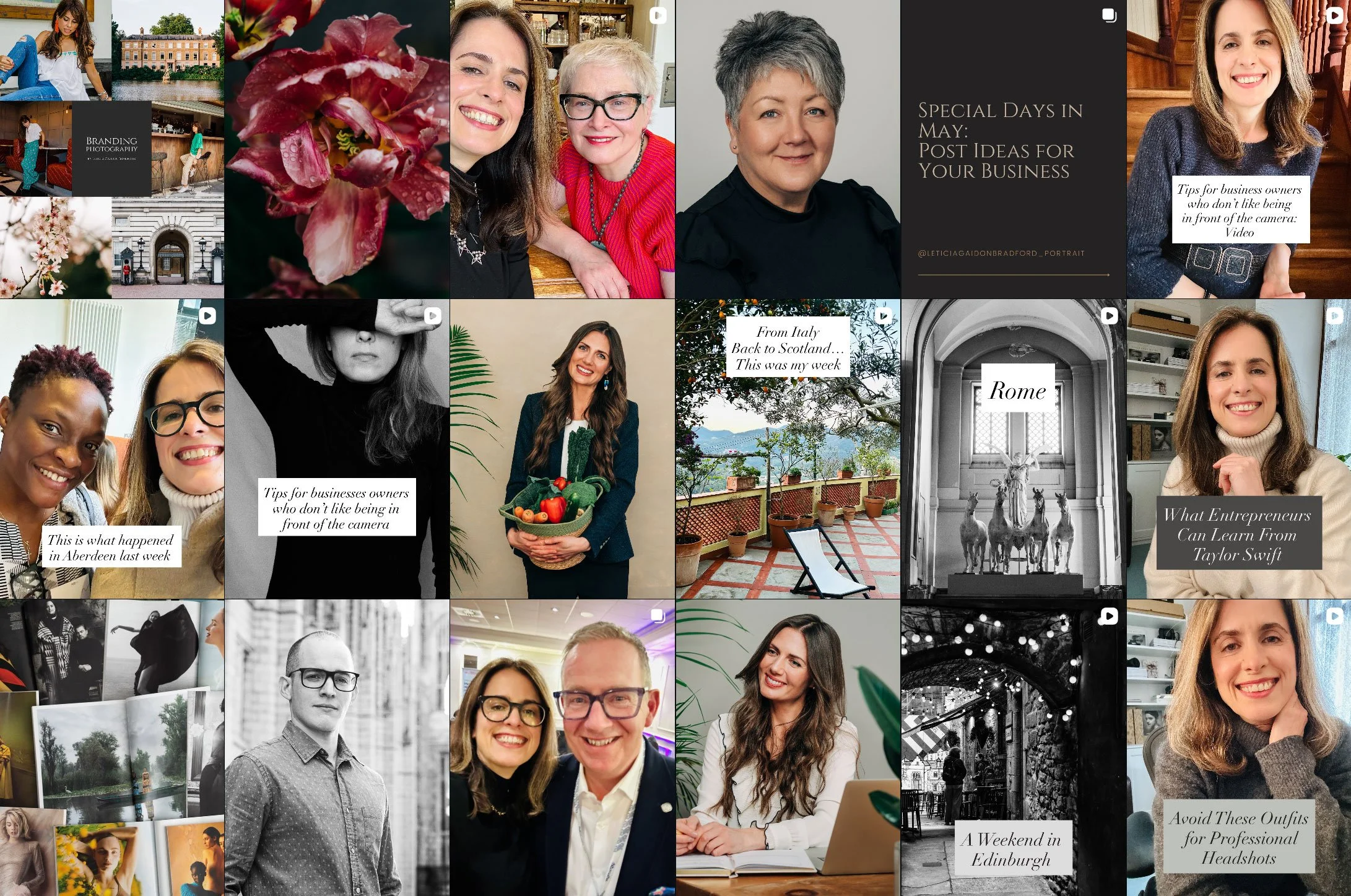
A website proves that you can provide the service. Social media gives people a reason to want to know you.
©2026 Leticia Gaidon Bradford Photography. All Rights Reserved.
People arrive with different intentions
Our website communicates, hopefully effectively, that we are a solution to a particular problem or need, so we are addressing a more problem-solving mindset.
As I mentioned before, we need to answer the basic questions of someone who is intentionally searching for a service:
Can this person do what I need? What does their work look like? How much does it cost? Where are they based?
This means that a business website needs to answer practical questions relatively quickly while establishing credibility and demonstrating expertise.
But not everyone arrives with the same level of intention.
Someone who discovers you through Instagram may not even be thinking about hiring a photographer. They may simply be curious about what you do, love your work, or want to know more about the person behind the business or the brand.
Something made them “click” and decide to follow your business, moving the needle from search behaviour to social behaviour.
And I think this distinction is important because the person who is actively searching for a photographer is already closer to making a decision, while the person who discovers you on social media may be nowhere near that stage.
They might simply like your work, your personality or the way you see the world, and that is where social media becomes interesting.
A website can establish authority without creating a deeper connection
Therefore, I would like to highlight the two different effects these platforms can have, because they are addressing different statements:
“This person knows what they are doing.”
“Can I see myself working with this person?”
Both can sell, depending on the target clients you are addressing.
For a family portrait, a prospect may be more influenced by feelings and emotional connection. For a business service, efficiency, quality and professionalism may carry more weight.
There is, of course, an overlap between both examples, but usually people prioritise some factors more than others when deciding who they want to work with.
And the relevance of these different factors is influenced by the tone we decide to communicate through our website and social media.
So, how do we show these distinctions?
Authority can come from your portfolio, qualifications, experience, testimonials, services, publications, awards and the results you have achieved for your clients. Here you answer the questions: “Can you do it?”
Connection comes from your writing, personality, opinions, stories, aesthetic choices and the way you communicate what matters to you. Here you answer the question: “Do I want you to do it for me?”
Of course, our websites also have space to create connection, particularly through our blogs and the way we communicate our values and personality.
I don't think blogs are less important because social media is more immediate. Quite the opposite.
Blogs are essential because they create a body of content that belongs to you and can continue to be discovered through search engines and, increasingly, AI-powered search.
Social media, on the other hand, is a platform that is lent to you.
You don't own that space or the relationship with the platform. Your account exists at the mercy of a third party, along with all the content and hard work you have invested there.
Your website and your blog are your own digital property.
This is one of the reasons I believe having your own website and creating useful, relevant content is becoming more important, not less.
This post is not about choosing between one or the other. It is about understanding that they serve different purposes and therefore require different approaches.
“Social media isn’t a brand strategy. Social media is a channel. While it’s important for a brand to develop something to say, it’s more important to create something that will be heard”
Your website is the shop window, but social media plays a different role
To establish and preserve authority on your website, you need to show your expertise clearly.
For a business owner or professional, this means showing what you do, who you help, the quality of your work, your experience and how you can solve a particular problem or need. Your website should make it relatively easy for a potential client to understand whether you are capable of providing the service or product they are looking for.
This is where professional photography, good design and clear information become important. The way your business is presented online contributes to the perception of your professionalism and the quality of what you offer.
But social media is a completely different game.
On social media, you can mix professional content with moments captured on your phone. You can show your office, your team, your work in progress, a meeting, a behind the scenes event, something you are working on, something you have learned, a thought about your industry or simply something that gives people a better idea of who is behind the business.
If you are careful to maintain a visually pleasing presence and a reasonable level of quality, this type of content can actually reinforce the connection you have with your audience and, it gives people more information to decide whether they can see themselves working with you.
Again, on social media, spontaneity and authenticity have an important value.
We also need to remember that social media is not usually where people go with the same mindset as when they use Google to search for a service.
People go there to be distracted, entertained, inspired and, sometimes, educated. Different platforms have different purposes, but the important point is that people are not usually opening Instagram or LinkedIn thinking, “I wonder which business I can buy something from today.”
And this is particularly important for business owners.
People rarely follow a business account simply because they want to watch advertising.
People don't follow businesses on social media to watch adverts.
“If your stories are all about your products and services, that’s not storytelling. It’s a brochure”

©2026 Leticia Gaidon Bradford Photography. All Rights Reserved.
How many times I said that? So, you received the memo.
If advertising is not the reason people follow us, what is the reason?
Now, the key question is: What makes someone decide that our business is worth following when they are not currently looking to buy from us?
Perhaps they find our content useful, or they learn something from us. Maybe they enjoy the way we communicate and possibly they want to keep up with what we are doing.
As a business is fundamentally important that, when the time comes that they actually need our service, they already feel that they know enough about us to consider getting in touch.
And this is where social media becomes much more interesting than simply another place to advertise.
The question is not “How can I sell more on social media?”
The better question is:
“Why would someone want to follow my business if they are not ready to buy from me?”
And, more importantly, what should businesses actually post on social media if they want people to stay?
That is what I want to explore in Part 2.
Thank you for reading this.
Follow me in Instagram. Connect with me in LinkedIn.
Bye for now.